

What Does a Balanced Meal Actually Look Like?
Your told to eat more protein but you aren't sure how. This article walks through a five step process to bring balance and nutrition to your next meal, no weight loss required

Protein is all the rage right now, and it’s been added to everything. It can be confusing to decide whether you should focus solely on protein and skip carbohydrates, or refocus on eating a variety of foods. What makes it even more confusing is if you’re trying to prevent or manage diabetes. Does it make sense to limit or cut out carbs? When everyone has an opinion, it’s hard to know what to do.

Yet you don’t want to get caught up in another fad diet. You want to know how to meet your protein goals without dieting. You want to understand how to eat a balanced meal that meets your nutritional needs, not just your protein target.
If you’re new to No Weight Loss Required, welcome. I’m Megrette, a weight-inclusive dietitian and diabetes educator. I write NWLR because I know that diets don’t work long-term, and that if changing the way you eat were easy, you would have already done it. This newsletter is for people who want to prevent or manage diabetes without dieting and who are ready to try a different approach.
I created the No Weight Loss Required Roadmap, a four-step approach to creating sustainable change. Here is the full Roadmap
From July through September, we’re on Step 1: Food Math: It’s Time to Stop Subtracting Food from Your Diet. Instead of focusing on restriction, we are going to explore the radical idea of adding more flavor, nutrients, pleasure, and flexibility to your meals. A great question to start with is, “What can I add to this meal to make it more balanced?”
You’re reading NWLR because you’re looking for a way to take care of yourself that doesn’t involve another set of rules. That’s what we’re building toward here, and I’m glad you’re along for it.
So what would it look like to eat 75 grams of protein? Start by dividing 75 grams by the number of meals you eat. If you eat three meals a day, that’s about 25 grams of protein per meal.
The next question worth asking is whether you want only protein at that meal. A protein shake or a high-protein yogurt can get you to 25 grams quickly, but these grab-and-go choices are rarely satisfying and lack balance. Let’s assume you want to eat a meal. That’s where the 5-step process comes in.
If you’re just getting started with Step 1, these two articles are a good place to begin.
Why become a paid subscriber?
As a paid subscriber, you’ll learn how to create balanced meals that meet your protein needs and are actually satisfying. Over the next three months, each article walks you through one step of the 5-step process so you can build meals that work in your real life, without dieting.
Let’s start building the meal with protein. It’s where the process starts and you’ll add to it from here.
Step 1 is to start with your protein. This is your anchor. It sets the tone for the rest of the plate.
Step 2 is to add carbohydrates. Carbohydrates are your body’s preferred source of energy and add fiber to your meal. A meal without carbohydrates isn’t balanced. It’s missing the fuel that keeps your energy steady and your hunger manageable.
Step 3 is to add color and texture. This is the step that makes a meal satisfying, not just nutritious. When your plate has three colors and three textures, you tend to feel more satisfied at the end of the meal. Non-starchy vegetables do most of the work here.
Step 4 will help you understand how to reduce the amount of saturated fat in your diet. Saturated fat is linked with heart disease. Four-footed animals like beef and pork carry more saturated fat than two-footed ones like chicken and turkey, or no-footed ones like fish. Knowing what’s on your plate helps you make informed choices without avoiding anything.
Step 5 is to see how it all comes together. This is where meal ideas show you exactly what Steps 1 through 4 look like on a real plate, across different foods and preparations.
Over the next three months, paid subscribers will get a full article on each step, with handouts, meal ideas, and the numbers so you can see how the pieces add up.
Let me show you what this looks like with eggs.
Step 1 — Protein
Two large eggs give you about 12 grams of protein. That’s a good start, but to reach 25 grams, you’ll want to add a protein partner. Some options that work well with eggs are cottage cheese stirred into a scramble or shredded cheddar melted in. Each of these adds around 7 to 13 grams of protein, depending on how much you use.
Step 2 — Carbohydrates
For Step 2, you’re adding carbohydrates and fiber. Toast, half a bagel, or a bowl of grits are common pairings with eggs that add carbohydrates and make the meal feel more complete. Choosing higher-fiber options like a Bagel Thins or whole-wheat toast with 3 or more grams of fiber, or adding fruit on the side, brings fiber and color.
Step 3 — Color and Texture
For Step 3, ask yourself: What can I add for volume and color?
Non-starchy vegetables add volume without significantly increasing carbohydrate intake, and they provide vitamins and minerals your body needs that protein and grains alone don’t provide. When you skip this step, the meal can hit its protein and carbohydrate targets and still leave you feeling like something is missing. That’s because something is.
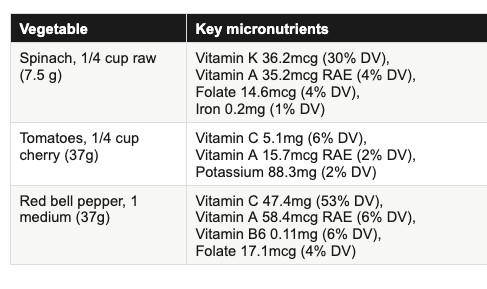
With eggs, this step is easy to overlook because eggs and toast fill the plate quickly. A handful of spinach wilted into the scramble, sliced tomato on the side, or sauteed bell peppers adds color, adds texture, and fills your plate with the micronutrients that make a meal genuinely nourishing rather than just complete on paper.
Here’s what three common additions actually contribute:
Step 4 — Count the Feet
To understand how much saturated fat is in a breakfast meal, count the number of feet. Four-footed animals like beef and pork carry the most saturated fat. Dairy is an animal product and also contains saturated fat, and where it falls in the framework depends on the fat content. Whole-fat dairy, including butter, whole milk, whole-fat cheese, and whole-fat yogurt, counts as four-footed. Reduced-fat dairy, including 2% milk, low-fat cottage cheese, and low-fat yogurt, counts as two-footed, meaning it has less saturated fat than whole-fat versions. Non-fat dairy, including skim milk, non-fat yogurt, and non-fat cottage cheese, counts as no-footed, meaning it has very little saturated fat. Fish is also no-footed.
At breakfast, this means that butter, whole-fat cheese, and pork sausage or a sausage patty all add saturated fat to your meal. Swapping to a chicken or turkey sausage moves you from four-footed to two-footed. Using low-fat cottage cheese in your scramble instead of whole-fat cheese does the same thing.
Step 5 — Three Simple Egg Breakfasts
Scrambled eggs with cottage cheese, whole wheat toast, and sliced tomato on the side. The cottage cheese is stirred into the eggs before cooking, which adds protein without significantly changing the texture. Adding toast, red tomato, and if you add spinach, will increase the color and texture.
Fried eggs over grits with turkey sausage on the side will help you meet your carbohydrate and protein goals. Shifting to turkey sausage keeps saturated fat lower than pork sausage, and a handful of sauteed bell peppers adds color and texture.
A veggie egg scramble with shredded cheddar, a whole Bagel Thin, and fresh fruit. The cheddar melts into the eggs, adding flavor and protein. The Bagel Thin and fruit provide the carbohydrates, color, and fiber.
Eating a balanced diet doesn’t have to be confusing. You can work with me at Nourish. Most Nourish clients have no co-pay. If you’d like to work with me directly, use my link to find an appointment.
The NWLR Roadmap is the best place to begin if you want to understand where we’re headed and why.